Wholesale Jewelry Tools: A Buyer’s Guide for Retailers and Distributors
If you sell jewelry tools through a shop, an online store or a distribution business, the range you carry decides how often customers come back. This guide is for retailers, wholesalers and importers in Europe, the USA, the UK and the Middle East. It covers which tools beginners and professionals ask for first, how to check quality before you order in bulk, and what to ask a manufacturer about samples, lead times and selling under your own brand. It comes from Pik Pak Tools, which has made jewelry tools in Sialkot, Pakistan, since 1985 and supplies companies in more than 50 countries.
The core range your customers will ask for
Most jewelry makers start with the same handful of tools and add more as their work grows. Stock the first group in depth, and add the rest as your customers move on to metalwork.
- Round nose pliers: loops, jump rings and curves in wire. Core stock.
- Chain nose pliers: gripping wire and opening jump rings. Core stock; many customers buy two.
- Flat nose pliers: holding wire and making sharp bends. Core stock.
- Flush cutter: cutting wire with a clean, flat end. Core stock.
- Nylon jaw pliers: straightening wire without marks. Add soon.
- Ring mandrel: sizing and shaping rings. Core stock for metalwork.
- Steel bench block: a flat surface for flattening and stamping. Core stock for metalwork.
- Chasing hammer and a nylon or rawhide mallet: flattening, texturing and shaping. Core stock for metalwork.
- Saw frame: cutting sheet metal. Stock it for customers who move into metalwork.
- Tweezers: picking up stones and small parts. Steady seller.
- Calipers or a wire gauge: measuring wire and stones. Steady seller.
- Disc cutters and dapping blocks: making blanks and domes. Specialist stock for established makers.
The pliers and cutters that sell every day
Round nose pliers have two smooth, tapered round jaws. Customers wrap wire around them to make loops, jump rings and spirals; the taper gives small or large loops depending on where they work. See our round nose pliers.
Chain nose pliers have half-round jaws that taper to a fine point, for gripping wire, opening and closing jump rings and reaching into small spaces. See our chain nose pliers, 130 mm.
Flat nose pliers have wide, flat jaws that hold a piece firmly and make clean right-angle bends. See our flat nose pliers, 130 mm.
A flush cutter leaves one side of the cut wire flat, so loops close neatly and wire ends do not scratch. Customers who work with memory wire or stainless steel need a cutter with tungsten carbide (TC) tips. See our flush cutter with TC tips and the full range of jewelry cutters.
Nylon jaw pliers have replaceable plastic pads instead of steel jaws. They straighten wire and hold finished pieces without scratching silver, gold, copper or plated wire. See our flat nose pliers with nylon jaws.
Metalwork tools: mandrels, blocks and hammers
A ring mandrel is a tapered steel rod marked with ring sizes. If you sell in more than one market, stock both size systems: number sizes for US customers and letter sizes for UK and Irish customers. See our ring mandrel 1 to 15, ring mandrel A to Z+6 and all mandrels and sizers.
A steel bench block gives a hard, polished, flat surface for flattening wire, stamping and texturing. Many customers buy a rubber block with it to cut the noise. See our double-sided steel and rubber bench block.
A chasing hammer has a wide, flat face for flattening and striking punches and a ball end for texture, and a nylon or rawhide mallet shapes metal without marking it. See our chasing hammers and the full jewelry hammers and mallets range.
A saw frame cuts shapes and pierces designs in sheet metal; adjustable frames keep using broken blades. See our saw frame with tension nut and all saw frames.
Fine point tweezers and gauges, calipers and dividers sell steadily to every level of maker. Disc cutters and dapping tools sell to established makers producing pieces in numbers.
Kits or single tools?
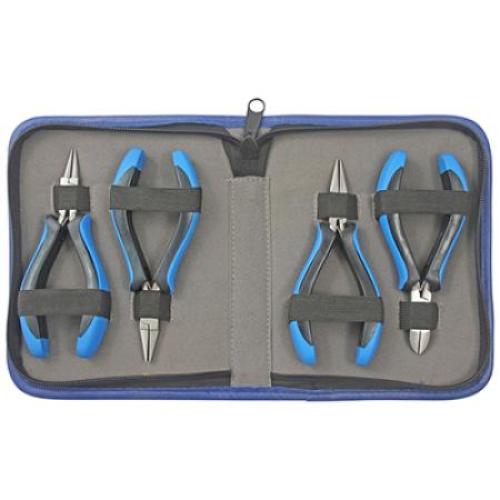
Stock both. Kits are an easy first purchase for beginners, a natural gift and the standard choice for training classes, so they bring in new customers. Single tools bring them back: professionals replace a worn pair of pliers or add a specialist shape. See our 5-piece ergonomic pliers kit, 7-piece beading tools kit and all pliers sets and tool kits.
Quality checks before you order in bulk
- Tips: close the pliers and look at the tips. They should meet evenly, with no gap and no play in the joint.
- Jaws: smooth jaws should be polished, with no tool marks, because any mark transfers to soft metal.
- Spring: it should open the pliers fully and evenly, without sticking.
- Cutters: the blades should meet along their whole length. Test on copper wire: a flush cutter leaves one end flat.
- Handles: grips should fit tightly and not twist.
- Hammers and mallets: heads should sit firmly, with smooth faces.
- Consistency: check several pieces of the same model, not just one sample. A good batch looks and works the same.
What to ask a jewelry tool manufacturer
- The minimum order quantity per model and per order.
- Lead times for stock models and for private label orders.
- Which models can be sampled, and how quickly.
- Branding options: marking on the tool, and packaging such as cards, pouches, cases and barcodes.
- Specifications for each model: length, jaw type, joint, finish and handle.
- Their quality system, for example ISO 9001 certification.
- Compliance documents your market needs, such as REACH for the EU and UK, or Proposition 65 labelling for California.
- Shipping terms (Incoterms), air or sea freight, and which export documents are included.
Selling tools under your own brand
Private label lets a retailer or distributor sell a range under its own name. The usual steps are: choose the models, approve samples, agree the marking and packaging, approve a pre-production sample, then production and inspection before shipping. Pik Pak Tools makes tools and kits with customers’ own branding and packaging for companies in Europe, the USA, the UK and the Middle East.
Care advice to pass on to your customers
- Keep tools dry. Humid workshops and coastal air rust steel. Wipe tools with a lightly oiled cloth and store them in a closed box or drawer.
- Oil the joint. One drop of light machine oil every few weeks keeps pliers opening smoothly.
- Cut only what the cutter is made for. Standard flush cutters are for soft wire such as copper, brass, silver and gold. Steel wire chips them; use a TC-tipped or heavy-duty cutter.
- Store pliers apart so the jaws do not knock together and lose their smooth finish.
Common questions
Which jewelry tools sell best to beginners?
Round nose, chain nose and flat nose pliers and a flush cutter, often bought together as a kit.
What is the difference between a flush cutter and a side cutter?
Both cut at the side of the jaws. A flush cutter leaves one end of the wire flat; a standard side cutter leaves a pointed end.
Do you sell to individual customers?
No. Pik Pak Tools supplies companies only: retailers, wholesalers, distributors and importers in Europe, the USA, the UK and the Middle East. We do not sell within Pakistan.
Can we see prices before we order?
Yes, after a free registration. Registered buyers see the full range of more than 4,500 tools with wholesale prices.
Sourcing from Pik Pak Tools
Pik Pak Tools has made jewelry tools in Sialkot since 1985: pliers, cutters, hammers, mandrels, tweezers, saw frames, disc cutters and dapping tools, as well as watchmaking and optical tools. We are ISO 9001:2015 certified and export to companies in more than 50 countries. Register free to see the full range and wholesale prices, or contact our team about samples and private label.